

Binary MLM software runs a compensation plan in which every member has two legs, left and right. Product BV (business volume) in the two legs is paired, commission is paid on the weaker leg, and the stronger leg's balance is carried forward or flushed, within caps. Coded Idea’s Mohali (Sector 127) team builds that pair engine around your plan for direct selling businesses in India: ₹15,000 ready-to-launch, ₹35,000 custom.
Last updated:
A binary plan looks simple until the first busy week: where a new member goes, what a cap does to unpaired BV, and how often one rupee gets paid. We work through each of these below with numbers. As a binary MLM development company, we also build the genealogy, e-wallet, KYC, apps and payouts as part of our end-to-end MLM software development.
Schedule a CallBinary MLM software price
Two starting points, shown in US dollars first (approx.) with the rupee price alongside.
These are starting prices. Final pricing is quoted after a short scoping call, once we know your pairing rules, caps and bonuses.
How a Binary MLM Plan Works: Left Leg and Right Leg
Every member has exactly two positions directly below them, a left and a right. Everyone placed below the left position, however deep, is the left leg, and the same goes for the right. A member can sponsor as many people as they like, but only two sit directly under them, so the rest are placed lower down.
Binary pays on balance. If the left leg has ₹90,000 of BV this week and the right has ₹1,45,000, the plan pays on the ₹90,000 that can be matched. The extra ₹55,000 on the right is not paid now. Depending on your plan, it is either carried to next week or flushed. Unlike a matrix or unilevel plan, binary has no depth limit, so BV from someone 30 levels down still counts in your leg.
Placement vs Sponsor: Spillover and Auto-Placement Rules
Every member has two links, and the software stores both:
- Sponsor: who referred them. Sponsor and matching bonuses follow this line.
- Placement parent: whose position they sit in. Binary BV flows up this line.
When a sponsor's two positions are full, a new recruit is placed lower down, under someone else. That is spillover. Aman has Bhavna on his left and Chetan on his right, and he sponsors Divya (the names are illustrative). Where she goes depends on the auto-placement rule:
| Rule | Where Divya goes |
|---|---|
| Extreme left or right | The first empty position at the bottom of Aman's outer left (or right) line |
| Weaker leg | The leg with less BV, or fewer members, this period; the plan must say which |
| Alternate | Left, then right, in turn, for each person Aman sponsors |
| Sponsor chooses | The leg Aman picks, with a default if he picks nothing |
If Divya lands in Bhavna's left position, Bhavna is her placement parent and Aman stays her sponsor. Her BV counts in Bhavna's left leg, Aman's left leg and one leg of every placement upline above them. A two-wide forced matrix looks similar, but it stops at a fixed depth and pays by level, not by pairing.
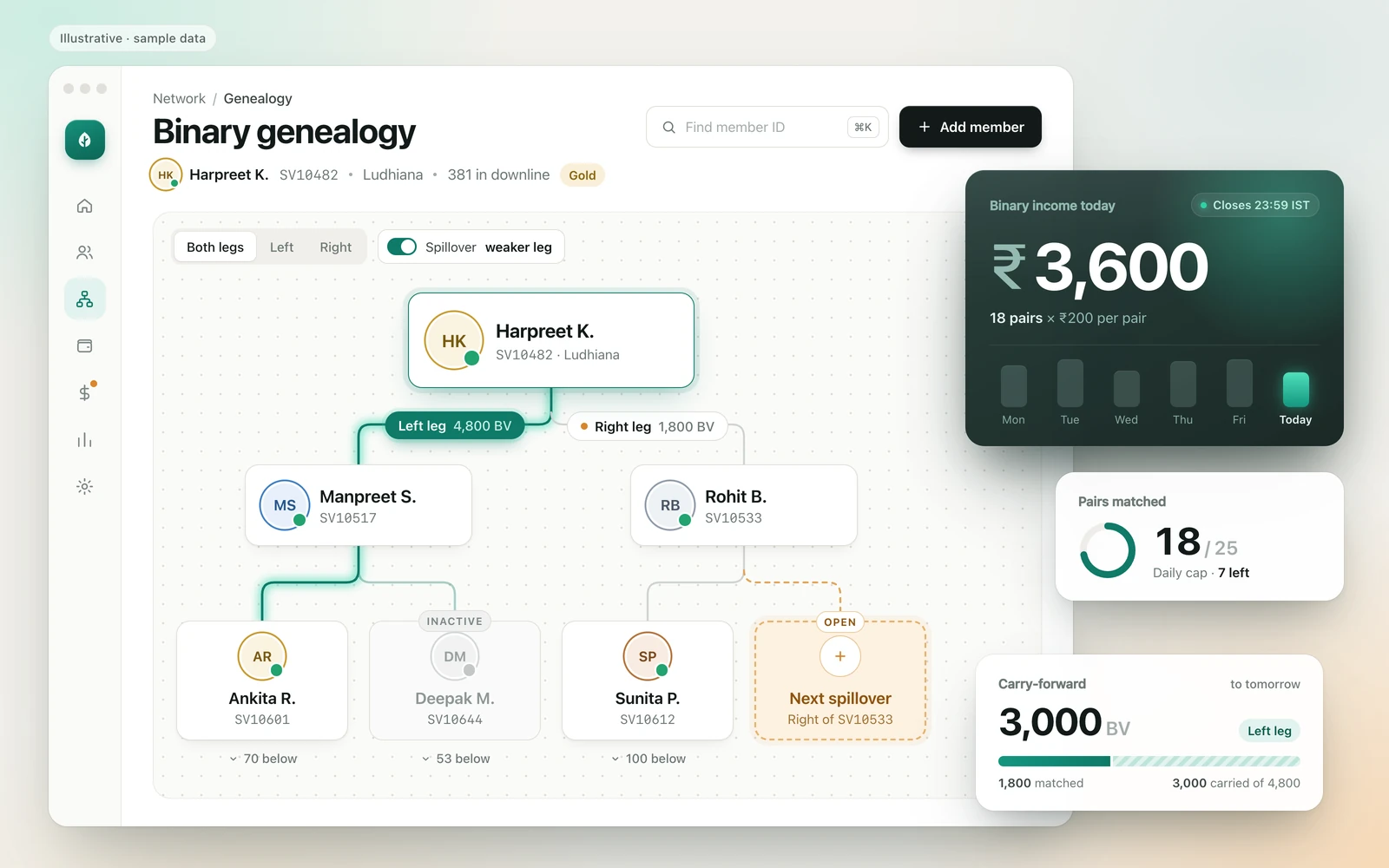
Pair Matching on Product BV: 1:1, 2:1 and 1:2
A pair is a fixed amount of BV matched from each leg. In our examples, ₹1,000 on the left plus ₹1,000 on the right make one pair. BV comes only from product orders; a ₹1,500 wellness kit might carry ₹1,000 BV. A joining fee or a product-free "activation pack" must never form a pair.
- 1:1: every pair takes one unit from each leg.
- 2:1 or 1:2 first pair: a member's first pair needs two units on one side and one on the other, and every later pair is 1:1. The plan must say whether the side is fixed or can be either.
Divya's first week has ₹2,500 BV on the left and ₹1,800 on the right:
- 1:1 At 1:1, she forms 1 pair, leaving ₹1,500 and ₹800.
- 2:1 At 2:1, she also forms 1 pair, but it takes ₹2,000 from her left, leaving ₹500 and ₹800.
- 1:2 At 1:2, she forms none, because her right leg holds less than ₹2,000.
Many plans also require a member to be active (their own product order this period) and to have sponsored one active member in each leg before any pair pays.
Pair Rate, Binary % and Capping
The pair rate is what one pair pays, such as ₹100 per ₹1,000 pair. Expressed as a binary %, that is 10% of matched weaker-leg BV. The software stores one and shows the other.
A cap limits binary income per member per period. It can be daily (say, 10 pairs a day) or weekly (say, ₹6,000). It can also be a pair count, which still holds if the pair rate changes later, or it can be set by rank.
Pairs above the cap are flushed. In many plans, the BV behind them is used up along with the money. Others stop only the money and leave the BV in the legs, which builds far larger carry-forward balances. The plan must say which. If it has both daily and weekly caps, it must also say which applies first (usually the daily cap).
Carry-Forward: Stronger Leg, Limits and Lapses
After pairing, one leg usually has BV left over. The carry-forward rule decides what moves into the next period:
| Rule | What carries to the next period |
|---|---|
| Stronger leg only | The stronger leg's balance; the weaker leg's leftover lapses |
| Both legs | Every rupee left on either side |
| Stronger leg, with a limit | The stronger leg's balance, up to a limit such as ₹50,000 |
| No carry-forward (flush) | Nothing; both legs restart from zero |
Plans also set lapse rules, such as expiry after a set number of periods or when a member becomes inactive. Every carried rupee is a promise. At 10%, ₹55,000 carried is ₹5,500 the company may pay later, so the carry-forward ledger should show the company's total at every close.
A Worked Binary Week: Aman's Pairs, Cap and Carry-Forward
Aman's plan pays ₹100 per ₹1,000 pair (10%) at 1:1, with a weekly cap of ₹6,000. BV behind capped pairs is flushed, and the stronger leg carries with no limit. Aman is active and qualified.
| Aman's binary | Week 1 | Week 2 |
|---|---|---|
| Carried in (left / right) | ₹12,000 / ₹0 | ₹0 / ₹55,000 |
| New BV (left / right) | ₹78,000 / ₹1,45,000 | ₹40,000 / ₹10,000 |
| Total (left / right) | ₹90,000 / ₹1,45,000 | ₹40,000 / ₹65,000 |
| Pairs formed | 90 | 40 |
| Gross binary at ₹100 per pair | ₹9,000 | ₹4,000 |
| Paid after the ₹6,000 cap | ₹6,000 | ₹4,000 |
| Over the cap (flushed) | ₹3,000 (30 pairs) | ₹0 |
| Carried out (left / right) | ₹0 / ₹55,000 | ₹0 / ₹25,000 |
In week 1, the 90 pairs (including the 30 capped ones) use up ₹90,000 from each leg, leaving ₹55,000 on the right. In week 2, that carry-forward pays off. Without it, the right leg would hold only ₹10,000, giving 10 pairs and ₹1,000 instead of ₹4,000. With a ₹50,000 carry limit, ₹5,000 lapses, but week 2 still forms 40 pairs and ₹20,000 carries out. TDS comes off the net binary later. These figures are plan arithmetic, not anyone's expected income.
Check a Binary Payout: Free Binary Plan Calculator
Enter one member's leg BV, your pair size, pair rate, cap and carry-forward rule. The result is plan arithmetic, not a prediction of anyone's earnings. How the numbers are worked out is explained step by step in our binary MLM commission calculator guide: pairing and carry-forward.
- Carried in (left / right)₹12,000 / ₹0
- New BV (left / right)₹78,000 / ₹1,45,000
- BV per pair₹1,000 · 1:1
- Pay₹100 per pair
- Cap per period₹6,000
- Carry-forward ruleStronger leg
90 pairs. ₹6,000 paid, ₹3,000 flushed by the cap.
Your legs held ₹90,000 left and ₹1,45,000 right, which made 90 pairs at ₹100 each (₹9,000). The cap paid ₹6,000 and flushed ₹3,000; the ₹30,000 of BV in each leg behind those pairs is used up. ₹0 carries on the left and ₹55,000 on the right.
| Item | Amount |
|---|---|
| Left leg total (carried + new) | ₹90,000 |
| Right leg total (carried + new) | ₹1,45,000 |
| Pairs formed | 90 |
| Gross binary | ₹9,000 |
| Over the cap (flushed) | ₹3,000 (30 pairs) |
| Net binary paid (before TDS) | ₹6,000 |
| Carry-forward to next period, left / right | ₹0 / ₹55,000 |
Illustrative arithmetic only. Real payouts depend on qualification, returns, rank caps and TDS. This is not an estimate of anyone's earnings.
First question we'd ask you: does your cap flush the BV behind the capped pairs (₹30,000 in each leg here), or only the money?
Nothing is sent until you press Send, and you can edit the message first.
The Payout Ceiling: One Rupee, Many Pairing Uplines
Binary has no depth limit, so one order counts in a leg of every placement upline above it. Each qualified upline who has it in their weaker leg, and is under their cap, pairs it and pays on it again. Take one ₹1,000 BV order at 10%:
| Uplines who pair the same order | Binary paid | Share of the order's BV |
|---|---|---|
| 1 | ₹100 | 10% |
| 3 | ₹300 | 30% |
| 5 | ₹500 | 50% |
| 8 | ₹800 | 80% |
Add a 10 / 5 / 5% matching bonus, and each pairing upline costs 12%. Five uplines then take 60% of BV, against a margin that may be about 35% after product cost, GST, logistics and returns.
Caps, flush rules and stronger-leg positions hold this down, although BV in a stronger leg is only carried, which delays the cost rather than removing it. None of these is a fixed number, so the software should report the binary payout ratio at every close: binary paid divided by the period's total BV. A week with ₹25,00,000 of BV that paid ₹3,50,000 in binary ran at 14%. Set a ceiling for that ratio before launch, and test every rule change against it.
Matching Bonus on Top of Binary
A matching bonus pays a member a share of the binary income of the people they sponsored, by sponsor depth. It follows the sponsor line and is paid on binary actually paid, after the cap. Aman's sponsor, Jaspreet, earns 10% at depth 1: ₹600 on Aman's week-1 ₹6,000, not ₹900 on the ₹9,000 calculated before the cap.
Adding matching and unilevel pay on repeat orders turns a binary into a binary + unilevel hybrid with matching bonus, where BV routing and a combined ceiling decide the cost. To compare plan shapes, see our unilevel vs binary vs matrix comparison and the generation plan with breakaway guide.
What Binary MLM Software Must Handle
- A genealogy tree showing both legs, each member's sponsor and placement parent, and leg totals and carry-forward on every node.
- Placement rules as admin settings, with locking so two sign-ups in the same second never take the same position.
- A pair engine that runs at a fixed cut-off, applies the first-pair ratio once per member and checks qualification.
- A cap and flush log showing, for every member and close, the pairs formed, paid and flushed, and the cap that applied.
- A carry-forward ledger with the opening balance, new BV, BV used, BV lapsed and closing balance for each leg at each close, plus the company's total.
- An e-wallet with typed credits (binary, matching, sponsor bonus).
- Returns. The order form must state the buyer's right to return a saleable product for a full refund (rule 6(1)(d) of the Direct Selling Rules). A return reverses the BV in every upline's leg, and binary already paid on it is clawed back as your plan states.
- KYC. Identities and addresses must be verified (rule 5(1)(i)), and sensitive personal data must be stored in India (rule 5(5)).
- TDS on commission. Under the Income-tax Act, 2025, in force from 1 April 2026, TDS on commission falls under section 393(1), which replaced section 194H. The rate is 2% once a distributor's commission for the tax year crosses the ₹20,000 TDS threshold (a tax-law limit, not a software price), and a higher rate applies without PAN. Weekly binary adds up quickly, so the software keeps a running total per PAN across closes. Confirm current rates with your CA.
- Admin approval of each payout run, with a preview of totals, flushed amounts, TDS and the binary payout ratio.
- An audit log of every override (who, when and why), with the close recalculated before payout.
Binary Plans and India's Direct Selling Rules
India's Consumer Protection (Direct Selling) Rules, 2021 define a "Pyramid Scheme" as a multi-layered network in which subscribers gain a benefit from enrolling others (rule 3(1)(h)). They prohibit such schemes (rule 10) and ban entry and subscription fees (rule 7(ii)(f)). The old pattern of "₹1,000 joining = 1 pair" pays for enrolment, not sales. We build pair matching, ranks and every bonus on product BV only. Registration can be free, and no income comes from joining fees. This is general information, not legal advice. Have a lawyer review your plan. For the full rules, read Is MLM legal in India? Direct Selling Rules 2021 explained.
Common Mistakes in Binary Plans
- Pairing joining packs. If a pack exists mainly to create BV, the plan pays for enrolment. The Rules also bar persuading buyers that they can recover the price by referring others (rule 7(4)).
- Not saying what the cap flushes: only the money, or the BV behind it as well.
- Unlimited carry-forward with no lapse rule, so the carried liability grows every week.
- Testing the ceiling with one upline, when every upline holding the order in their weaker leg can pair it.
- Paying matching on binary before the cap.
- A vague first-pair rule, so 2:1 ends up applied to every pair, or to none.
- Advertising capped weekly income as typical. Claims must be capable of substantiation (rule 7(i)(d)).
Binary MLM Software Price in India
Binary MLM software from Coded Idea starts from ₹15,000 for a ready-to-launch platform with pair matching, capping and carry-forward, the e-wallet and the admin dashboard.
It includes every placement, cap and carry-forward option described on this page. A custom build with your own commission rules, design and integrations starts from ₹35,000. Crypto MLM software starts from ₹30,000 ready-to-launch, or ₹45,000 custom. Hybrid builds, such as binary with unilevel and a matching bonus, and enterprise builds are quoted after a short call. We confirm the timeline after reviewing your plan document. See what affects MLM software price in India.
Binary MLM Software FAQs
How is a pair calculated in binary MLM?
Divide the BV in each leg by the plan's pair size and take the smaller number. With ₹1,000 BV per pair, ₹90,000 left and ₹1,45,000 right make 90 pairs. In a 2:1 or 1:2 plan, only the first pair needs two units on one side.
What is capping and flush-out in a binary plan?
A cap limits binary income per period, daily, weekly or by pair count. Pairs above it are flushed: they are not paid, and in many plans their BV is used up rather than carried.
What happens to carry-forward BV in a binary plan?
The stronger leg's unpaired balance moves to the next period, in full or up to a limit. It can lapse after a set number of periods or when a member is inactive. Some plans carry nothing.
What is the difference between sponsor and placement in a binary plan?
The sponsor referred the member; the placement parent is the position they sit under. Binary BV flows up the placement line, while sponsor and matching bonuses follow the sponsor line.
Is a matching bonus paid before or after the binary cap?
After. It is a share of binary actually paid, so it never rewards income the cap removed.
Can I change caps or carry-forward rules after launch?
Yes, from a cut-over date at the start of a payout period, with members told in advance. We test a plan change on a copy of the live network before switching it on.
Is a binary MLM plan legal in India?
The Direct Selling Rules ban no particular plan shape. A binary that pairs joining fees is a prohibited Pyramid Scheme; one that pairs genuine product sales is not. Take legal advice on your plan.
Which company develops binary MLM software in India?
Coded Idea, from its Mohali (Sector 127) team, develops binary MLM software for direct selling businesses across India. We build the pair engine around your own plan: your pair size and ratio, caps, flush-out and carry-forward rules, rather than a fixed template. It is one of many vendors, so compare it against our guide to the best MLM software company in India and the checks below.
How do you review binary MLM software before you buy?
Ask for a demo that runs on your own numbers, not a slideshow. Then check five things. First, run a payout test: give the vendor a worked week with your pair size, cap and carry-forward rule and compare the result with your own arithmetic. Second, ask what the cap flushes, the money only or the BV too. Third, get source-code ownership in writing. Fourth, ask who owns the member data and where it is stored. Fifth, get a written scope that lists every rule. Our MLM software demo checklist has the full list.
How much does binary MLM software cost in India?
Binary MLM software from Coded Idea starts from ₹15,000 for a ready-to-launch platform with pair matching, capping and carry-forward, the e-wallet and the admin dashboard. A custom build with your own commission rules, design and integrations starts from ₹35,000. Crypto MLM software starts from ₹30,000 ready-to-launch or ₹45,000 custom. Hybrid and enterprise builds are quoted after a short call. See MLM software price in India for what changes the price.
Send Us Your Binary Plan
Share your pair size, pair rate, caps and carry-forward rules, even as a rough note. We will show you what your cap flushes, how large your carry-forward ledger can grow and where your payout ceiling sits. Call +91 90580 85796 or email info@codedidea.com. We work from Mohali and Bengaluru with founders across Chandigarh, Mohali and Panchkula (see our MLM software development company in Chandigarh page) and online across India. See our MLM software build process for how a project runs from plan review to launch. Comparing vendors? Read our guide to the best MLM software company in India, the MLM software demo checklist and binary vs unilevel MLM plan.
Let’s TALK
Ready to bring your idea to life?
Contact Now