

Unilevel MLM software runs a compensation plan where every distributor you personally sponsor sits on your first level, with no limit on width, and you earn a set percentage on purchases made a fixed number of levels deep. Coded Idea's Mohali (Sector 127) team builds that engine for direct selling businesses in India: level percentages, compression, rank and infinity bonuses, autoship and TDS deductions, from ₹15,000 ready-to-launch or ₹35,000 custom.
Last updated: 9 November 2026
Unilevel suits businesses that sell consumables people reorder every month. It is easy to explain, but the money is in the details. You need to decide how many levels pay, who counts as active, what happens when an upline is inactive, and whether the total stays within your margin. Below, we work through each one with real numbers. Our MLM software development team builds from exactly this kind of brief.
Unilevel MLM software price
Two starting points, shown in US dollars first (approx.) with the rupee price alongside.
These are starting prices. Final pricing is quoted after a short scoping call, once we know your levels, percentages and bonuses.
Width vs Depth: How a Unilevel Tree Is Shaped
Everyone you personally enrol sits directly under you on level 1. There are no legs and no fixed slots, so there is no spillover. If you sponsor 40 people, you have 40 frontline distributors. Their recruits form your level 2, and so on.
Width is unlimited, but paid depth is not. The plan fixes how many levels earn commission, commonly 5 to 10. Volume below that earns nothing unless an infinity bonus applies. Unilevel therefore rewards building and supporting a wide frontline. It also means one member may have hundreds of direct recruits. The genealogy screen needs search, filters and paging, not one oversized tree drawing.
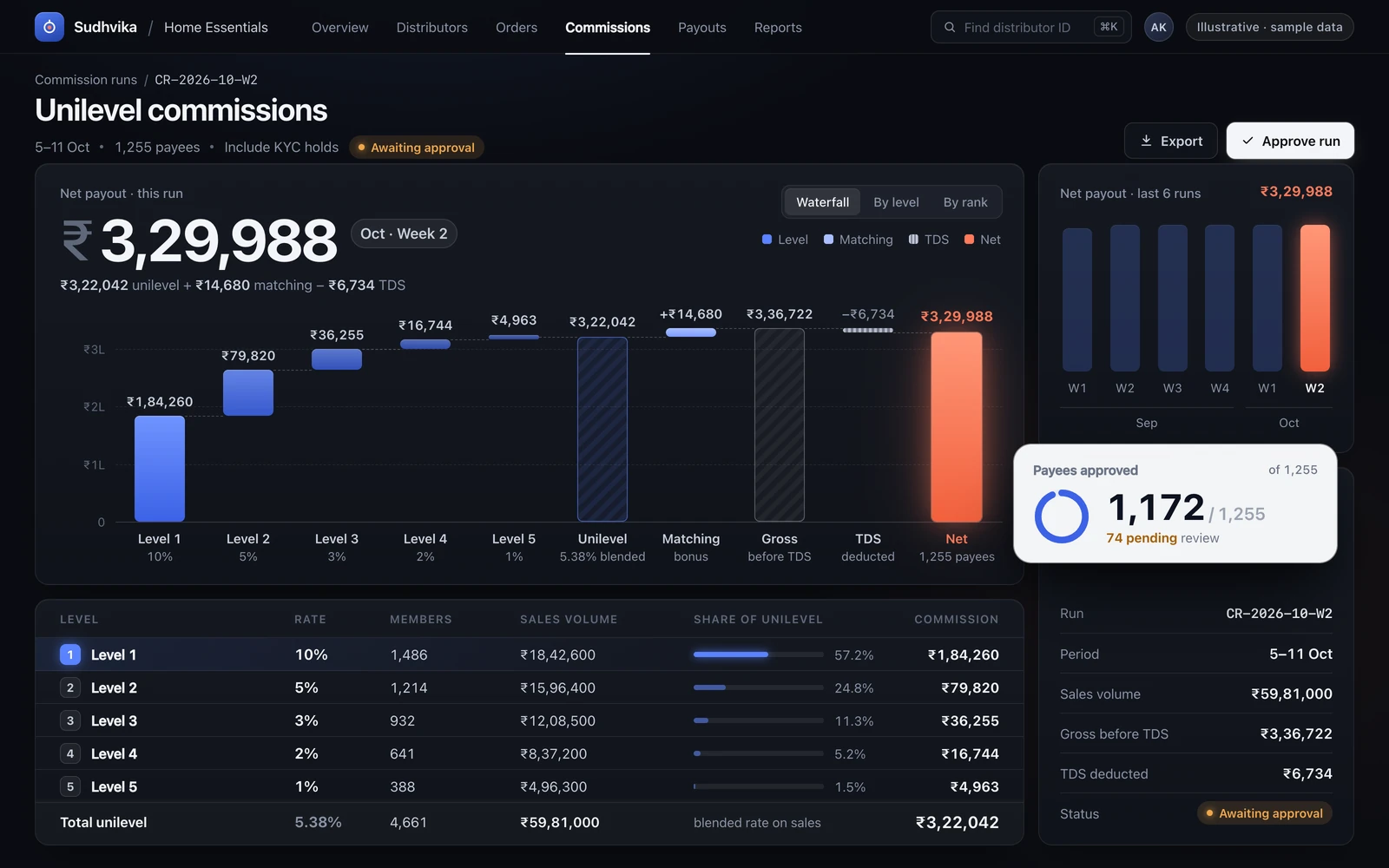
How Unilevel MLM Software Calculates Level Commissions
Worked example: 5 levels at 10 / 5 / 3 / 2 / 1%
A distributor buys a product with a business volume (BV) of ₹1,000. The software walks up the sponsor line and pays five uplines:
| Level | Who earns | Rate | Commission |
|---|---|---|---|
| 1 | Direct sponsor | 10% | ₹100 |
| 2 | Sponsor's sponsor | 5% | ₹50 |
| 3 | Next upline | 3% | ₹30 |
| 4 | Next upline | 2% | ₹20 |
| 5 | Next upline | 1% | ₹10 |
| Total | 21% | ₹210 |
Level 1 pays most because the person closest to the buyer usually did the selling and support. What matters to your finance team is the total: 21% of BV leaves on every sale before any other bonus. Companies usually set BV per product, often below the selling price on thin-margin items.
Why the total payout needs a ceiling
Matching, infinity, rank and leadership bonuses all come out of the same rupee of sale. So before any code is written, fix a payout ceiling. That is the share of BV your margin can fund after product cost, GST, logistics and overheads. Suppose the ceiling is 40% and levels take 21%. Every other bonus then shares the remaining 19 points. Test that figure at the worst case, with every level qualified and compression on. The software should enforce the ceiling with per-rank caps. It should also flag any payout run that goes over budget before the run is released.
Worked example: one distributor's month from a whole team
The first example prices one sale. A founder also needs to see a month for one distributor. Take Asha (an illustrative name). She sponsors 3 people, each of them sponsors 3 more, and so on for five paid levels. Every member buys ₹1,000 BV through autoship in the month, and the plan pays 10 / 5 / 3 / 2 / 1%.
Each level holds three times as many members as the one above it. Asha earns ₹300 + ₹450 + ₹810 + ₹1,620 + ₹2,430 = ₹5,610 on ₹3,63,000 BV from 363 members. Levels 4 and 5 pay ₹4,050 of that (72%) even though they carry the two lowest rates, which is why compression and the payout ceiling matter most on the deep levels.
| Level | Members | Rate | Commission |
|---|---|---|---|
| 1 | 3 | 10% | ₹300 |
| 2 | 9 | 5% | ₹450 |
| 3 | 27 | 3% | ₹810 |
| 4 | 81 | 2% | ₹1,620 |
| 5 | 243 | 1% | ₹2,430 |
| Total | 363 | ₹5,610 |
Illustrative figures, not an income claim. The table assumes a full tree where every member buys ₹1,000 BV. Real teams are rarely full, members who do not buy add no BV, and every other upline in the network is paid the same way, so model the whole network, not one top member. Try your own width, depth and percentages in the free calculator below, or follow the method step by step in our unilevel MLM commission calculator guide.
Free tool · Unilevel MLM commission calculator
Unilevel MLM Commission Calculator: What Will Your Plan Pay Out?
Set your level percentages and payout ceiling. You'll see what each sale pays, what share of BV your levels use and what your monthly commission bill could be. It all runs in your browser; nothing is saved or sent.
₹210 of a ₹1,000 BV sale
Share of your payout ceiling used by levelsRoom for other bonuses.
…
Opens WhatsApp with your numbers filled in. Nothing is sent until you press send.
Estimates only. Real payouts also depend on qualification rules, ranks, caps, TDS and other bonuses. We test your exact plan with sample data before launch.
Unilevel MLM Software in Delhi NCR, Built from Mohali
Founders in Delhi, Noida and Gurugram who want unilevel MLM software in Delhi NCR work with our Mohali team online. We have no Delhi office, and plan reviews and demos run on video calls. The unilevel MLM commission calculation is the same in any city, so use the free unilevel commission calculator above with your own levels and percentages, then share the result with us and we will check it against your plan.
Ready-to-launch unilevel software starts from ₹15,000 and custom builds from ₹35,000. See how we work with businesses in the region on our MLM software company in Delhi NCR page.
Compression: What Happens When an Upline Is Inactive
Most unilevel plans pay only active distributors, usually those who made a minimum personal purchase that month. Here is the same ₹1,000 BV sale, where the second upline, Bharat, missed his purchase (illustrative names):
| Upline | Status | No compression | Dynamic compression | Roll-up only |
|---|---|---|---|---|
| Asha | Active | L1: ₹100 | L1: ₹100 | ₹100 |
| Bharat | Inactive | ₹0 | skipped | ₹0 |
| Chetan | Active | L3: ₹30 | L2: ₹50 | ₹30 + ₹50 = ₹80 |
| Deepa | Active | L4: ₹20 | L3: ₹30 | ₹20 |
| Farhan | Active | L5: ₹10 | L4: ₹20 | ₹10 |
| Gurpreet | Active | L6, unpaid: ₹0 | L5: ₹10 | ₹0 |
| Total paid | ₹160 | ₹210 | ₹210 |
- No compression: Bharat's ₹50 stays with the company (often called breakage).
- Dynamic compression: Bharat is skipped for this run only, and everyone above him moves up a level. He keeps his place and earns again once he is active.
- Roll-up: only Bharat's unpaid ₹50 passes to the next active upline. Every other level stays the same.
Compression is fairer to active members, but the full ₹210 goes out far more often. Model your ceiling with compression switched on.
Infinity, Override and Matching Bonuses on a Unilevel Plan
Infinity (override) bonus
An infinity bonus pays qualified leaders a small percentage on volume below the last paid level, say 1% from level 6 down. Payment continues down a line until it reaches another leader of equal or higher rank, and stops there. Without that block, several leaders get paid on the same volume. Plans often add a differential: a higher-rank leader earns only the gap between their rate and the rate of the lower-rank leader below them. On every run, the software has to search each line past level 5 and apply these rules.
Matching bonus
A matching bonus pays a percentage of the level commissions earned by distributors you personally sponsored. Worked example (illustrative figures): with a 20% match, if your direct recruit Neha earns ₹2,500 this month, you receive ₹500. It fits unilevel's focus on the frontline. It is paid on top of commissions, though, so it must fit inside the ceiling. Plans commonly limit it to qualified ranks and to one to three sponsorship generations.
Businesses That Fit a Unilevel Plan
Unilevel works best where income comes from repeat purchases. Typical examples are wellness and nutrition, Ayurvedic and herbal products, personal care, home care and FMCG, and agri-inputs. Many of these businesses add autoship, a standing monthly order. The software then needs:
- a repurchase store and BV per product
- autoship with retries for failed payments
- an active-status check that reads those orders automatically
Unilevel vs Binary vs Matrix: Which Plan to Choose
| Factor | Unilevel | Binary | Matrix |
|---|---|---|---|
| Frontline width | Unlimited | 2 positions | Fixed (e.g. 3 or 4) |
| Paid depth | Fixed levels | Deep, paid on weaker leg | Fixed by matrix size |
| Spillover | None | Yes | Yes |
| Income driven by | Repeat purchases across levels | Balanced two-leg volume | Filling positions, cycles |
| Hardest software part | Compression, active checks, wide genealogy | Pair matching, capping, carry-forward | Placement algorithm, re-entry |
| Best fit | Consumables, autoship, easy-to-explain plans | Team-building focused on two legs | Small, capped or board-style networks |
Choose unilevel when your products are reordered monthly and you want to reward each distributor's own frontline. For a plan built on two balanced teams, compare binary MLM software. For a capped structure with automatic placement, see matrix MLM software. If leaders should earn deeper through rank breaks, a generation MLM plan can replace unilevel or run alongside it.
Common Mistakes in Unilevel Plans
- Percentages before a ceiling. Rates are chosen to look attractive, and the total is checked only after launch.
- Too many thin levels. Twelve levels at 0.5% sound generous but leave new distributors with almost nothing.
- No active rule, or one nobody can meet. Without a rule, dormant accounts get paid. If no one can meet the rule, most commission becomes breakage.
- Paying on joining fees. India's Consumer Protection (Direct Selling) Rules, 2021 define a "Pyramid Scheme" by the benefits earned from enrolling further subscribers. An entity running one is excluded from being a direct selling entity. Commissions should come from genuine product sales. Our guide Is MLM legal in India? Direct Selling Rules 2021 explained walks through the rules. Take legal advice on your plan.
- No reversal on returns. The same rules require the order form to state the buyer's right to return a product in saleable condition for a full refund. Your software therefore needs to claw back commissions paid on refunded orders.
What Unilevel MLM Software Must Handle
- Level unlock rules: for example, 1 active personal recruit opens levels 1–2, 3 recruits open levels 3–4, and 5 recruits open all five.
- Active-status checks every cycle, based on personal BV and autoship orders.
- Commission runs: level, matching and infinity bonuses usually run monthly. Retail or fast-start bonuses, if your plan has them, can run weekly. Each run is previewed and approved before money moves.
- Plan rules: a compression mode (none, dynamic or roll-up), rank qualification, caps and the payout ceiling.
- TDS on commission: the Income-tax Act, 2025 replaced the 1961 Act from 1 April 2026. TDS on commission, earlier under section 194H, now falls under section 393(1). The rate is 2% once a distributor's commission in the tax year crosses the ₹20,000 threshold (a tax-law limit, not a software price), and a higher rate applies where PAN is not furnished. The software captures PAN at KYC and tracks each distributor's cumulative commission. It deducts TDS at the right point and exports the data for quarterly TDS statements. Confirm current rates with your chartered accountant.
- Refund reversals and an audit log for every wallet entry.
What's Included in a Coded Idea Unilevel Build
- Admin panel with plan settings: levels, rates, active rules, compression and caps
- Distributor back office with a frontline list and downline genealogy
- Repurchase store, BV per product and autoship
- E-wallet, payout requests and bank payouts
- KYC with PAN capture, plus TDS reports
- Rank, matching and infinity bonus modules
- Replicated distributor websites and Android/iOS apps
- Testing of the commission engine on sample networks before go-live
Unilevel MLM Software Price in India
Unilevel MLM software from Coded Idea starts from ₹15,000.
Custom unilevel builds start from ₹35,000. Crypto MLM builds with token or USDT payouts start from ₹30,000 (custom crypto from ₹45,000). Hybrid and enterprise plans are quoted after a short call. We confirm the delivery timeline after reviewing your plan document. To see what changes the cost, read our MLM software price in India guide.
Unilevel MLM Software FAQs
How many levels should a unilevel plan pay?
Usually 5 to 10. Fewer, stronger levels tend to work better than many thin ones, because new distributors earn most from their first few levels. If leaders need to earn deeper, add an infinity bonus.
What happens to commission from an inactive distributor?
It depends on your compression setting. With none, the share stays with the company. With dynamic compression, uplines move up a level. With roll-up, only the unpaid share passes to the next active upline.
Can levels unlock based on personally sponsored members?
Yes. Deeper levels can open as a distributor's count of active personal recruits grows. For example, levels 1–2 can open with one recruit and all levels with five. The rules are rechecked on every commission run.
Does the software deduct TDS on distributor commissions?
Yes. It captures PAN and tracks each distributor's yearly total against the threshold. It deducts 2% under section 393(1) of the Income-tax Act, 2025 (earlier section 194H) and exports the data for your TDS statements.
Can autoship orders count towards active status?
Yes. A scheduled monthly order generates BV and marks the distributor active automatically. Failed payments are retried, and the distributor is alerted before the active-status check runs.
Can a unilevel plan include matching or generation bonuses?
Yes. Both are common add-ons. Each one draws from the same payout ceiling, so we configure them together and test the combined total before launch.
Is a unilevel plan allowed under India's direct selling rules?
The Direct Selling Rules do not ban any plan shape. They exclude pyramid schemes, where benefits come from enrolling others. A unilevel plan that pays on genuine product purchases, not joining fees, stays on the right side of that line. Take legal advice for your specific plan.
How is unilevel MLM commission calculated?
Each upline is paid the level's percentage of the business volume (BV) of the sale, and the software repeats that for every level the plan pays. Example only, not a price: on a ₹1,000 BV sale with 10 / 5 / 3 / 2 / 1% across five levels, the five uplines earn ₹100, ₹50, ₹30, ₹20 and ₹10, a total of ₹210 (21% of BV). The active check, compression and the payout ceiling are applied on top. Try your own percentages in the free unilevel commission calculator on this page.
Do you build unilevel MLM software for Delhi NCR businesses?
Yes. Coded Idea builds unilevel MLM software for businesses in Delhi, Noida, Gurugram, Ghaziabad and Faridabad. We do not have a Delhi office. The team works from Mohali (Sector 127) and Bengaluru, and plan reviews, demos and updates run on video calls and WhatsApp. Ready-to-launch unilevel software starts from ₹15,000 and custom builds from ₹35,000. See our MLM software company in Delhi NCR page, and use our MLM software demo checklist before you commit.
Unilevel vs binary: which is better for a new MLM company?
Neither is better in every case. Unilevel suits products people reorder every month and a plan that is easy to explain: unlimited frontline width, commission on fixed levels and no spillover. Binary suits team building on two legs, but it needs pair matching, capping and carry-forward rules, and it can be harder to explain to new distributors. To choose, write down your payout ceiling, then test both plans on the same sample sales. Our binary vs unilevel MLM plan guide compares them side by side, and our binary MLM software page shows what a binary build includes.
How much does a unilevel upline earn from a whole team in a month?
There is no fixed figure: it depends on how many members sit on each paid level, their BV and your level percentages. Example only, not an income claim: if a distributor has 3 direct recruits, each of them has 3 more, and so on for five levels, and every member buys ₹1,000 BV in the month, the 363 members at 10 / 5 / 3 / 2 / 1% pay that upline ₹300 + ₹450 + ₹810 + ₹1,620 + ₹2,430 = ₹5,610. Real teams are rarely full, and members who do not buy add no BV. Try your own width, depth and percentages in the free calculator on this page or in our unilevel MLM commission calculator guide.
Why do unilevel plans pay smaller percentages on deeper levels?
Each level usually holds more members than the one above it, so even a small percentage adds up on a deep level. In a full tree where every member has 3 recruits, level 5 holds 243 members, and a 1% rate on ₹1,000 BV each still pays ₹2,430. Plans therefore usually pay the highest rate on level 1 and taper the rates down, and they fix a payout ceiling so the total stays inside the margin on every sale. We test the full-tree case on sample networks before go-live.
Is there free unilevel MLM software?
The unilevel commission calculator on this page is free and runs in your browser, and nothing is saved or sent. The software build is not free: ready-to-launch unilevel software starts from ₹15,000 and custom builds from ₹35,000. If you are looking at free downloads, read our guide Free MLM software download: what to check first before any member or wallet data goes near one.
Send Us Your Unilevel Plan
Share your compensation plan, even a rough draft, and we will tell you what the engine must handle. Call +91 90580 85796 or email info@codedidea.com. We work with founders across Chandigarh, Mohali and Panchkula (see our MLM software company in Chandigarh page) and online across India. The work is backed by our wider MLM software development services. Still comparing vendors? Our guide to the best MLM software company in India shows what to check.
Let’s TALK
Ready to bring your idea to life?
Contact Now