

Matrix MLM software runs a forced matrix compensation plan. Every member has a fixed number of frontline positions (the width) and earns on a fixed number of levels (the depth). Once a frontline is full, new members spill into the next open position below it. Coded Idea's Mohali (Sector 127) team builds the placement, payout and re-entry engine for direct selling businesses in India.
Last updated: 6 November 2026
A matrix looks simple on a slide. The trouble starts after launch: which slot a new member gets, who earns when an upline recruits into your leg, and what a completed matrix costs you. Below, we work through each of these with numbers. The rest of the platform (e-wallet, KYC, apps and payouts) comes with our custom MLM software development services. Matrix MLM software starts from ₹15,000 for a ready-to-launch platform or ₹35,000 for a custom build.
Matrix MLM software price
Two starting points, shown in US dollars first (approx.) with the rupee price alongside.
These are starting prices. Final pricing is quoted after a short scoping call, once we know your matrix size, depth and placement rules.
How a Forced Matrix Works: Width × Depth
A matrix is named width × depth. In a 3×3, each position has 3 slots directly below it, and commission is paid 3 levels deep. Each level is the width times the level above it:
| Matrix | Positions per level | Total positions in one matrix |
|---|---|---|
| 2×2 | 2, 4 | 6 |
| 3×3 | 3, 9, 27 | 39 |
| 3×9 | 3, 9, 27 … 19,683 | 29,523 |
| 4×7 | 4, 16, 64, 256, 1,024, 4,096, 16,384 | 21,844 |
| 5×7 | 5, 25, 125, 625, 3,125, 15,625, 78,125 | 97,655 |
Level n holds widthn positions, and one full matrix needs width × (widthdepth − 1) ÷ (width − 1). So a 3×3 needs 39 people below one member, while a 5×7 needs 97,655. Very few members will ever fill a deep matrix, so its completion bonus must never be presented as typical income.
In a forced matrix, the width is a hard cap, and anyone a member sponsors beyond it is placed lower down. In a free matrix the sponsor picks the slot. Most plans in India are forced.
Size Your Matrix: Free Matrix Plan Calculator
Pick a width and depth to see how many positions one matrix needs and what a full matrix would pay as a share of one position's product value. This only shows the plan's arithmetic. It does not predict what any member will earn.
3 + 9 + 27 = 39 positions
A 3×3 forced matrix has 39 positions. One member needs 39 people placed below them to complete it once.
Small matrix. It fills quickly, which is typical of boards and cyclers. Check what pays for each position.
| Level | Positions on this level | Running total |
|---|---|---|
| 1 | 3 | 3 |
| 2 | 9 | 12 |
| 3 | 27 | 39 |
Illustrative arithmetic only. Earnings depend on actual product sales, and a matrix pays this amount only when every position is filled and buys.
First question we'd ask you: what fills a position in your plan, a product purchase or a joining amount? Only the first is allowed under India's Direct Selling Rules.
Nothing is sent until you press Send in the form, and you can edit the message first.
Placement Rules: Where Does a New Member Go?
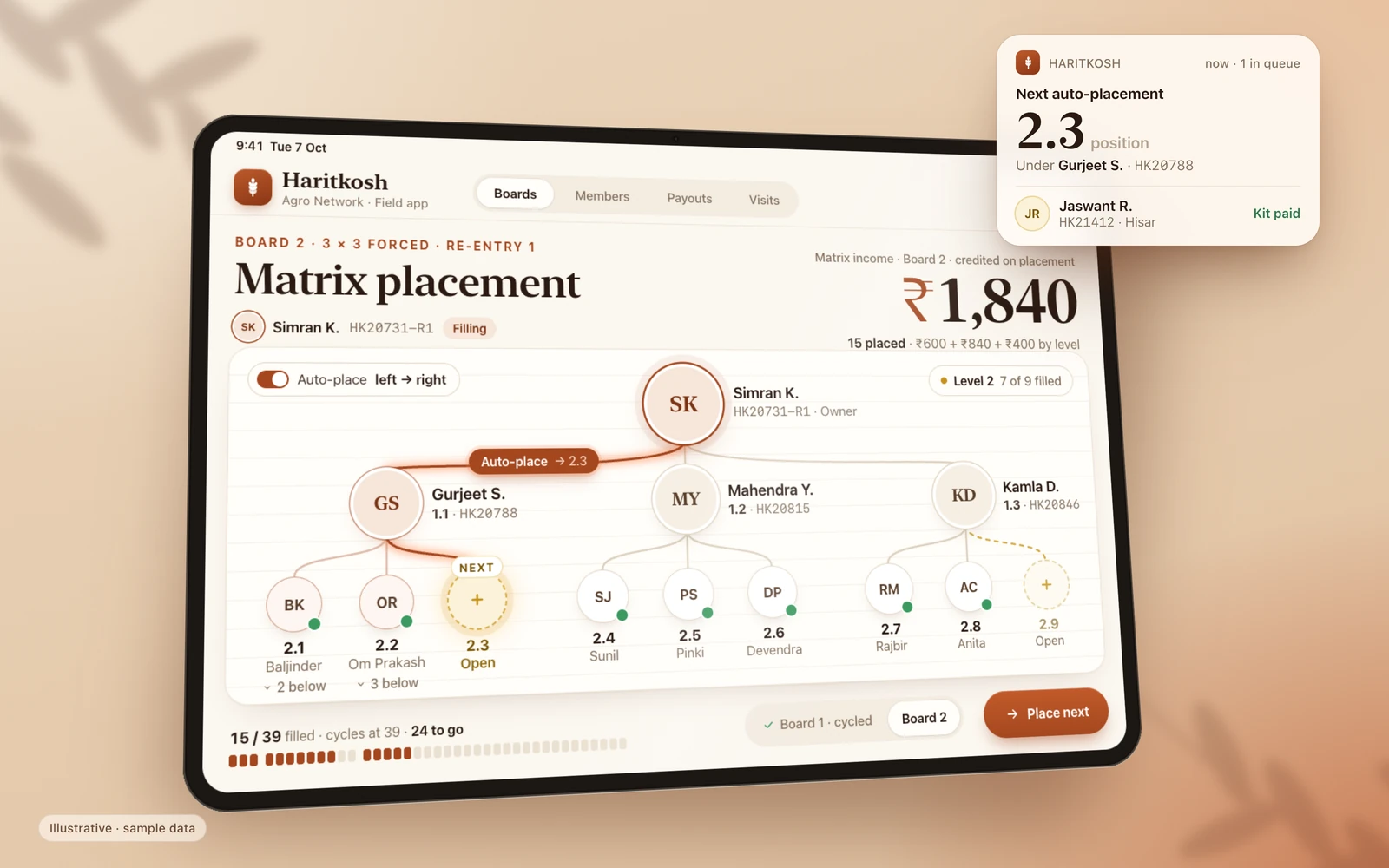
Placement is the heart of matrix MLM software, so the rules must be written down before any code. Four settings decide them:
- Fill order. Breadth-first fills a whole level before starting the next. Depth-first runs down one leg first. Most plans use breadth-first.
- Direction. Left-to-right fills the first leg's slots before the second leg's. Round-robin places one member in each leg in turn, which keeps the legs even.
- Sponsor-first. A new member takes the first open slot in their own sponsor's matrix, even if an earlier slot is open elsewhere in the upline's tree.
- Spillover from upline. Once an upline's levels are full, their new recruits go to the first open slot further down. That slot may be in your leg.
For every member, the software stores the sponsor (who referred them) and the placement parent (whose slot they occupy). Sponsor bonuses follow the first, and level commissions follow the second.
Worked example: placement in Ravi's 3×3 matrix
The settings are breadth-first, left-to-right and sponsor-first. Ravi has sponsored Asha, Bilal and Charu, so his level 1 is full. Meena is Ravi's sponsor. (The names are illustrative.)
| Order | New member | Sponsored by | Placed under | Why |
|---|---|---|---|---|
| 1 | Dev | Ravi | Asha (slot 1) | Ravi's level 1 is full, so Dev takes the first open slot on level 2, left to right |
| 2 | Esha | Bilal | Bilal (slot 1) | Sponsor-first: Bilal's own slot comes before Asha's open slots |
| 3 | Farhan | Ravi | Asha (slot 2) | Next open slot on Ravi's level 2 |
| 4 | Gita | Meena | Asha (slot 3) | Spillover: Meena's earlier slots are full, so her first open slot is in Ravi's leg |
Ravi's level 2 now shows 4 of 9 positions filled. Gita is in his matrix although he did not sponsor her. Meena earns any sponsor bonus on Gita. Because Gita sits on Meena's level 3, Meena also earns a level-3 commission on her purchases. Asha and Ravi earn at levels 1 and 2.
How Matrix Level Commissions Add Up
Worked example: 3×3 matrix at 5 / 4 / 3% on ₹1,000 BV
This example is illustrative. Every position in Ravi's matrix buys one product with a business volume (BV) of ₹1,000.
| Level | Positions | BV from level | Rate | Ravi earns |
|---|---|---|---|---|
| 1 | 3 | ₹3,000 | 5% | ₹150 |
| 2 | 9 | ₹9,000 | 4% | ₹360 |
| 3 | 27 | ₹27,000 | 3% | ₹810 |
| Total | 39 | ₹39,000 | ₹1,320 |
₹1,320 is Ravi's maximum, and he reaches it only if all 39 positions are filled and every one buys. From the company's side, each ₹1,000 sale pays at most ₹50 + ₹40 + ₹30 = ₹120 to the three uplines above it. That is 12% of BV, whatever the matrix size. Check that figure against your product margin.
The completion bonus costs more than it looks
Say the plan adds a bonus when a matrix fills, worth 2% of the matrix's BV (an illustrative rate, not a recommendation): ₹780 on Ravi's ₹39,000. Every position sits in up to three matrices, its placement parent's and the next two uplines', so one ₹1,000 sale can feed three completion bonuses. A "2%" bonus can therefore cost up to 6% of each sale. With level commission added, the worst case is 18% of BV. Fix the total ceiling first, then set the rates.
Cycling, Re-Entry and What Happens When a Matrix Fills
When the last position fills, the matrix completes, which is often called cycling. Your plan must answer three questions, and the software must enforce each answer:
- What is paid? A fixed completion bonus keeps the payout ceiling per completed matrix known in advance. In the illustrative example above, the ceiling is ₹1,320 + ₹780 = ₹2,100, which is 5.4% of the matrix's ₹39,000 BV.
- Does the member get a new matrix? In a re-entry plan, an empty matrix opens, either automatically or after a new product purchase. It is placed in the original sponsor's next open slot or in a company queue.
- How many times? Cap re-entries per member per period. Fix the queue order as first completed, first placed, so nobody jumps the line.
Be wary of auto re-entry paid by deducting earnings. If the deduction buys only a position and no product, the plan is paying for positions, not sales.
Board and Cycler Plans: Where a Matrix Becomes a Pyramid
A board, or cycler, is a small matrix, typically 2×2 or 2×3. When the bottom row fills, the top member "exits" with a payout and the board splits in two. The code is easy. The real question is where the money comes from.
If newcomers' joining amounts fund the exit payout, every payout depends on more people joining. India's Consumer Protection (Direct Selling) Rules, 2021 define a "Pyramid Scheme" as a multi-layered network in which subscribers enrol others to gain a benefit from that enrolment (rule 3(1)(h)). The Rules prohibit Pyramid Schemes and money circulation schemes (rule 10) and ban any entry or subscription fee (rule 7(ii)(f)). They also ban persuading buyers that they can recover the price by referring others (rule 7(4)).
We build matrix and board logic only where positions come from genuine product purchases and commission comes from those sales. We do not build boards, autopools or "helping plans" that pay mainly for joinings, in rupees or crypto. This is general information, not legal advice. Have a lawyer review your plan.
Matrix vs Binary vs Unilevel: Quick Decision Points
- Matrix: you want a known maximum payout per position, plus spillover that helps new members.
- Binary: your plan pays on two balanced team legs. A 2-wide matrix is not a binary: binary depth is unlimited and pays on weaker-leg volume, with pair matching and carry-forward. See binary MLM software.
- Unilevel: your best people recruit widely and sell monthly consumables. A matrix width cap would push their extra recruits into other legs. Our unilevel vs binary vs matrix comparison sets all three side by side.
- Both: matrix placement for first orders plus unilevel pay on repeat orders is a hybrid MLM plan.
- On-chain: a fixed-size forced matrix is the most common smart-contract plan, because the contract checks a known number of positions. See crypto MLM software.
What Matrix MLM Software Must Handle
- A placement engine with the four settings above as admin options. The same order of joins always gives the same result.
- A placement queue with locking, so two people joining in the same second never get the same slot.
- Re-entry and cycling with caps, a queue order and a record of every completed matrix.
- A matrix view for members that shows how full each level is ("Level 2: 4 of 9"), the next open slot and who spilled in from above.
- Admin override with an audit log. Each move records who made it, when and why, and affected commissions are recalculated before the next payout run.
- KYC. The Rules require direct sellers' identities and addresses to be verified (rule 5(1)(i)) and sensitive personal data to be stored in India (rule 5(5)).
- Refund reversals. The order form must state the buyer's right to return a saleable product for a full refund (rule 6(1)(d)). Commission on a returned order is clawed back, and the position is kept or back-filled, as your plan states.
- TDS on commission. Under the Income-tax Act, 2025, in force from 1 April 2026, TDS on commission falls under section 393(1), which replaced section 194H. The rate is 2% once a distributor crosses the annual threshold. The software captures PAN, tracks cumulative commission and exports TDS data. Confirm current rates with your CA.
- A payout preview and approval step before any money moves.
Matrix MLM Software Services: What We Build and Set Up
- Plan review first. Share your matrix size, placement rules and payout table. We review them and tell you what the placement engine must handle and where your payout ceiling sits.
- Placement and spillover engine. Fill order, direction, sponsor-first and spillover as admin settings, with a locked placement queue so no two members get the same slot.
- Commission and completion-bonus engine. Level commissions and completion bonuses checked against a payout ceiling per sale, with a payout preview and approval step before any money moves.
- Cycling and re-entry. Caps, a queue order and a record of every completed matrix.
- Member and admin screens. A matrix view for members, and admin overrides with an audit log.
- Compliance reports. KYC, refund reversals and TDS data, built around India's Direct Selling Rules, 2021. This is general information, not legal advice: read Is MLM legal in India? and have a lawyer review your plan.
- Wallet, payouts and apps. E-wallet, payouts and mobile apps come with our MLM software development services.
- Demo and comparison. Before you buy from anyone, test a demo with our demo checklist, and compare providers with our guide to the best MLM software company in India.
Common Mistakes in Matrix Plans
- Picking a size for how it sounds. A 5×7 has about 2,500 times as many positions as a 3×3. The Rules require claims to be capable of substantiation (rule 7(i)(d)), so show what a typical member earns, not what a full matrix pays.
- Counting the completion bonus once, when each sale can feed several matrices.
- Mixing up sponsor and placement parent, so bonuses reach the wrong person.
- Changing the placement order after launch without a written cut-off date.
- Having no rule for inactive positions. Decide whether a member who never buys keeps a slot, and where their share goes.
- Selling spillover as income. "Your upline will fill your matrix" is a promise nobody can keep, and the Rules prohibit misleading representations (rule 7(ii)(b)).
Matrix MLM Software Price in India
Matrix MLM software from Coded Idea starts from ₹15,000 for a ready-to-launch forced-matrix platform, or ₹35,000 for a custom build with your own commission rules, design and integrations.
Crypto MLM software with smart-contract or USDT payouts starts from ₹30,000 ready-to-launch, or ₹45,000 custom. Hybrid and enterprise builds, such as a matrix with unilevel repeat-order pay or several boards, are quoted after a short call. We confirm the timeline after reviewing your plan document. Our MLM software price in India guide explains what changes the cost.
Matrix MLM Software FAQs
How many positions are there in a 3×3 forced matrix?
39: 3 on level 1, 9 on level 2 and 27 on level 3. Each level is the width times the level above it. A 4×7 has 21,844 positions and a 5×7 has 97,655.
Where is a new member placed once my first level is full?
In the next open position below you, following your plan's placement order, usually breadth-first and left to right. With sponsor-first on, anyone you sponsor fills your own matrix before other open slots in your upline's tree.
What is the difference between a sponsor and a placement parent?
The sponsor referred the new member. The placement parent is the position they sit under. With spillover, these are often different people. Sponsor bonuses follow the sponsor, and level commissions follow the placement line.
What happens when a matrix is completed?
The member receives any completion bonus your plan sets. In a re-entry plan, a new matrix then opens and is placed by the plan's queue rule. The software records every completed matrix and enforces any re-entry cap.
Can the admin move a member after placement?
Yes, but every move is logged with who made it, when and why. Affected commissions are recalculated before the next payout run, and the upline sees the change in their matrix view.
Can I change the matrix size after launch?
Yes, with a migration rule. Usually, existing matrices keep their size until they complete, and new ones use the new size from a fixed date. Test the change on a copy of your live network first.
Is a board or cycler matrix plan legal in India?
The Direct Selling Rules ban no particular plan shape. But a board that pays mainly from newcomers' joining amounts is a prohibited Pyramid Scheme. Positions earned through genuine product purchases are a different matter. Take legal advice on your plan.
What are matrix MLM software services?
Matrix MLM software services cover the parts a matrix plan needs to run: the placement and spillover engine, level commissions and completion bonuses, cycling and re-entry with caps, member and admin screens with an audit log, and KYC, refund-reversal and TDS reports. The Coded Idea team in Mohali (Sector 127) starts with a plan review, then builds and sets it up. Matrix MLM software starts from ₹15,000 ready-to-launch or ₹35,000 custom. See MLM software pricing.
How do you calculate matrix MLM commissions?
Multiply the positions on each level by that level's rate and the product's business volume (BV), then add the levels. In the worked example on this page, a 3×3 matrix at 5 / 4 / 3% on ₹1,000 BV pays 3 × 5% = ₹150, 9 × 4% = ₹360 and 27 × 3% = ₹810, so ₹1,320 at most. These are illustrative figures, not prices, and ₹1,320 is reached only if all 39 positions are filled and every one buys. Try your own width, depth and rates in the free matrix plan calculator.
Forced matrix vs binary vs unilevel: which is better for a new MLM company?
Choose by what you want to control. A forced matrix suits a known maximum payout per position, plus spillover that helps new members. Binary suits a plan that pays on two balanced team legs. Unilevel suits a team that recruits widely and sells monthly consumables. Whichever you pick, test the payout against your product margin first. Our binary vs unilevel MLM plan comparison sets those two side by side, and we review your plan with you before you commit.
Send Us Your Matrix Plan
Share your matrix size, placement rules and payout table, even as a rough sketch. We will tell you what the placement engine must handle and where your payout ceiling sits. Call +91 90580 85796 or email info@codedidea.com. We work with founders across Chandigarh, Mohali and Panchkula (see our MLM software company in Chandigarh page) and online across India. Questions about matrix plans for Lucknow companies are covered on our Lucknow page. To see how a build runs from plan review to launch, read how we build MLM software.
Let’s TALK
Ready to bring your idea to life?
Contact Now